
 English

Thiết bị hàn và đánh bóng trang sức: Hướng dẫn thiết yếu cho thiết lập dây chuyền sản xuất
Jewelry Welding and Polishing Equipment: Essential Guide for Production Line Setup
Welding and polishing are the two most critical finishing steps in jewelry manufacturing. After cutting and forming operations produce the basic jewelry components, welding joins them together and polishing gives them the final surface quality that customers see and feel. This guide covers the key equipment types, application scenarios, and practical tips for integrating welding and polishing machines into your production workflow.
1. Jewelry Welding Machine Types and Applications
There are several types of welding machines used in jewelry manufacturing, each suited to different applications:
| Welding Type | Best For | Material Compatibility | Skill Level Required |
|---|---|---|---|
| Laser welding | Precision spot welding, chain repair, ring sizing | Gold, silver, platinum, K-gold, stainless steel | Intermediate |
| Resistance welding (spot) | Chain assembly, component joining | Gold, silver, copper, brass | Beginner to intermediate |
| Micro torch/oxygen-gas | Traditional soldering, larger components | All precious metals | Advanced (manual skill) |
| Induction welding | High-volume production, consistent joints | Gold, silver | Low (automated) |
Laser Welding Machines
Laser welding is the most versatile option for modern jewelry workshops. It delivers precise, localized heat that minimizes heat-affected zones — critical when welding near heat-sensitive components like stones or enamel. Laser welders are ideal for:
Ring sizing and repair
Chain link closing and repair
Component assembly (findings, clasps, settings)
Porosity filling in cast pieces
Precious metal restoration
Visit our jewelry welding machines page to see available models and specifications.
Resistance Spot Welding
Resistance welding uses electrical current to heat and fuse metal at the point of contact. It is faster than laser welding but less precise. Commonly used for high-volume chain assembly where the weld joint is small and consistent.
2. Practical Welding Tips for Gold, Silver, and Alloy Jewelry
Gold Welding
24K Gold: Use the lowest power setting and shortest pulse duration. Pure gold conducts heat very quickly and can deform easily. Multiple light passes are better than one heavy weld.
14K–18K Gold: Standard parameters work well. Pre-heating the components reduces thermal shock and improves weld penetration.
White Gold: The nickel or palladium content affects weld behavior. Test on scrap material first to find optimal settings.
Silver Welding
Silver has excellent welding characteristics — it flows well and produces clean joints. However, silver tarnish can interfere with weld quality. Clean the weld area thoroughly before welding. Silver's high thermal conductivity means it dissipates heat quickly; use slightly higher power settings than gold.
Platinum and Palladium
These metals require significantly higher welding temperatures. Use dedicated higher-power laser settings and ensure adequate ventilation (platinum welding produces fine metal vapor). Pre-heating is strongly recommended.
3. Jewelry Polishing Machine Types and Their Uses
| Machine Type | Best For | Speed Range | Dust Collection |
|---|---|---|---|
| Bench polisher (single/dual spindle) | General polishing, small workshops | Variable (1,400–3,400 RPM) | External or built-in |
| Magnetic polisher | Chain polishing, small components | Fixed or variable | Built-in |
| Ultrasonic cleaner | Final cleaning after polishing | N/A | N/A |
| Steam cleaner | Spot cleaning between polishing steps | N/A | N/A |
| Vacuum buff polishing machine | High-volume bangle and ring polishing | Variable | Integrated vacuum |
Bench Polishers
The workhorse of jewelry polishing. Dual-spindle models allow you to have a rough compound on one wheel and a fine compound on the other. Key features to look for: variable speed control (for different metals), left/right threaded spindles (so wheels don't loosen during use), and efficient dust collection ports.
Magnetic Polishers
Ideal for chain and small component polishing. The magnetic field causes polishing pins to vibrate and abrade the jewelry surface uniformly — reaching internal surfaces that bench polishing cannot access. This is particularly useful for chains, hollow beads, and complex-shaped pieces after ball diamond cutting.
Ultrasonic and Steam Cleaners
After polishing, jewelry must be thoroughly cleaned to remove polishing compound residue. Ultrasonic cleaners use high-frequency sound waves in a cleaning solution to dislodge residue from crevices. Steam cleaners provide a final hot-water rinse that leaves jewelry spotless.
Browse our polishing machine collection for all these equipment types.
4. A Professional Polishing Workflow
For the best surface finish, follow this sequence:
Pre-polish: Use a medium-grit compound (e.g., Tripoli) on a stitched muslin wheel to remove tool marks and surface irregularities from the cutting or forming stage
Final polish: Use a fine compound (e.g., rouge) on a loose flannel or fleece wheel for a mirror finish
Magnetic polish (optional): For chains or complex pieces, 10–20 minutes in a magnetic polisher
Ultrasonic clean: 3–5 minutes in ultrasonic cleaner with jewelry-specific cleaning solution
Steam clean: Final rinse with steam cleaner to remove any remaining residue
Inspect: Check under magnification for any missed areas or defects
5. Integrating Welding and Polishing into Your Production Line
Your complete production workflow, from raw material to finished product, should look like this:
Material Preparation: Wire/tube stock preparation, annealing if needed (learn why annealing matters)
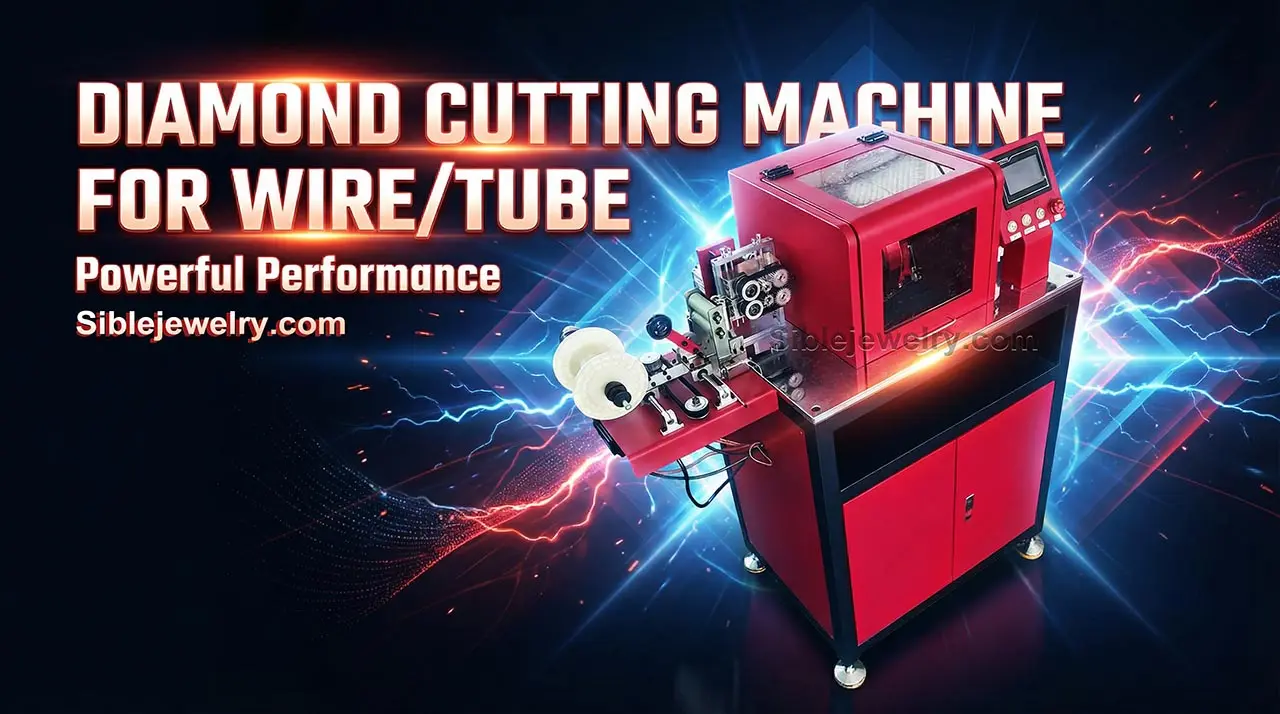
Cutting & Forming: Diamond cutting and forming operations using Sible cutting machines and forming machines
Assembly: Welding components together using appropriate welding equipment
Finishing: Polishing, cleaning, and final inspection
This integrated approach ensures smooth material flow from one production stage to the next, minimizing handling time and reducing the risk of damage between steps.
6. Selection Guide: Which Machines Do You Need?
For a Small Workshop (1–3 people)
1 laser welding machine (versatile, small footprint)
1 dual-spindle bench polisher with dust collection
1 ultrasonic cleaner
Estimated investment: Affordable entry point for jewelry repair and small-batch production.
For a Medium Factory (5–15 people)
1–2 laser welding machines (dedicated to different material types)
2–4 bench polishers (dedicated to rough and fine polishing)
1 magnetic polisher for chain and bead polishing
1 ultrasonic cleaner + 1 steam cleaner
For a Large Production Facility (15+ people)
Multiple laser welders (including dedicated high-power models for platinum)
Automated polishing line with vacuum buff machines
Industrial ultrasonic cleaning line
Dedicated inspection and QC station
Frequently Asked Questions
Can I use one polishing wheel for different metals?
It is not recommended. Dedicated wheels for each metal type prevent cross-contamination. A wheel used for copper polishing will transfer copper particles to a gold piece, causing surface discoloration. Use separate wheels for gold, silver, and base metals.
How often should I replace polishing compounds?
Polishing compound bars last for many applications. Replace them when the bar becomes too small to hold comfortably (about 1–2 cm remaining). The compound on the wheel should be refreshed by touching the bar to the spinning wheel for 1–2 seconds every few pieces.
Do I need ventilation for welding in my workshop?
Yes. Even laser welding produces fine metal vapor and fumes. Proper ventilation or fume extraction is essential for operator safety, especially when welding silver, brass, or any metal with alloying elements. Sible welding machines are compatible with standard workshop extraction systems.
How long is the typical learning curve for laser welding?
Basic laser welding operation can be learned in 1–2 days. Achieving consistent, high-quality welds on different materials and joint types typically takes 2–4 weeks of regular practice. Sible provides training documentation and remote support with every welding machine purchase. Start with our beginner's guide to jewelry machines.
What spare parts should I keep for welding and polishing equipment?
For welding: spare laser bulbs (if applicable), focusing lenses, and protective windows. For polishing: spare polishing wheels (muslin, flannel, fleece), polishing compound bars (rough and fine), and spare dust collection filters. Visit our spare parts page for genuine Sible components.
Related Resources
Để lại tin nhắn trực tuyến


